By the end of this chapter, the reader will be able to:
- Derive the log-likelihood function for the Rasch model and explain the role of person and item parameters.
- Implement maximum likelihood estimation (MLE) for IRT models using gradient ascent and L-BFGS optimization.
- Explain the identifiability problem in IRT and describe standard solutions (sum-to-zero, fixed anchor).
- Distinguish between joint MLE, conditional MLE, and marginal MLE, and articulate when each is appropriate.
- Implement the Expectation-Maximization (EM) algorithm for Rasch model estimation and explain the E-step and M-step.
- Describe Bayesian inference for IRT models and specify appropriate priors for ability and item parameters.
- Implement MAP estimation and MCMC sampling for IRT models.
- Explain regularization in IRT as a Bayesian prior and apply cross-validation for hyperparameter selection.
- Apply MLE and Bayesian methods to real AI benchmark data and compare their efficiency.
This chapter can be covered in 3 lectures (75-90 minutes each):
Lecture 1: Foundations of Estimation
- Why learning matters for AI measurement (15 min)
- Likelihood and log-likelihood for Rasch model (20 min)
- Gradient derivation and interpretation (20 min)
- Hands-on: MLE with synthetic data (20 min)
Lecture 2: Advanced Estimation Methods
- Identifiability and conditional vs marginal MLE (20 min)
- EM algorithm for IRT (30 min)
- Hands-on: EM implementation (25 min)
Lecture 3: Bayesian Approaches
- Prior specification for IRT (15 min)
- MAP estimation and MCMC (30 min)
- Regularization and cross-validation (15 min)
This chapter introduces estimation notation: \(\ell(\theta, \beta)\) (log-likelihood), \(\hat{\theta}_{\text{MLE}}\) and \(\hat{\theta}_{\text{MAP}}\) (point estimates), \(\pi(\theta)\) (priors), and \(\eta\) (learning rate). See the notation appendix for the complete notation reference.
A visual tour of the key concepts in this chapter — from maximum likelihood estimation and the EM algorithm to Bayesian inference and generalization.
4.1 Why Learning Matters for AI Measurement
Chapter 3 introduced the measurement models—Rasch, 2PL, Bradley-Terry—that describe how latent abilities generate observed responses. But knowing the form of a model is not enough. To actually use these models for AI evaluation, we must estimate their parameters from data. This chapter develops estimation for the unidimensional IRT models; the multidimensional factor model and the experiments that probe its generalization are estimated and analyzed in Section 7.2 and Section 7.5.
Given a response matrix \(Y \in \{0,1\}^{N \times M}\) where \(Y_{ij} = 1\) indicates model \(i\) answered question \(j\) correctly:
\[ \text{Find } \hat{\theta}, \hat{\beta} = \arg\max_{\theta, \beta} P(Y \mid \theta, \beta) \]
This optimization problem underlies all psychometric estimation and forms the foundation for trustworthy AI evaluation.
Parameter estimation serves several critical purposes in AI measurement:
Fair comparison: Calibrated item difficulties allow us to compare models tested on different question subsets. If we know that question A is harder than question B, we can appropriately weight their contributions to the final score.
Uncertainty quantification: Estimation procedures provide not just point estimates but standard errors, telling us how confident we should be in our measurements.
Adaptive testing: Once we have calibrated item parameters, we can select the most informative questions for each model, dramatically reducing evaluation costs (see Section 6.2.2 for a full treatment of Computerized Adaptive Testing).
Prediction: With learned parameters, we can predict how a model will perform on questions it has never seen, enabling efficient evaluation of new benchmarks.
This chapter focuses on passive learning: given a fixed dataset, estimate all parameters simultaneously. This includes maximum likelihood estimation (MLE), expectation-maximization (EM), and Bayesian inference. The design of which items to include in a benchmark, including active item selection, is the subject of Chapter 6.
4.2 Maximum Likelihood Estimation
Maximum likelihood estimation is the foundation of parameter estimation in IRT. The principle is simple: find the parameter values that make the observed data most probable.
4.2.1 The Likelihood Function
Recall from Chapter 3 that the Rasch model specifies the probability of a correct response as:
\[ P(Y_{ij} = 1 \mid \theta_i, \beta_j) = \sigma(\theta_i - \beta_j) = \frac{1}{1 + e^{-(\theta_i - \beta_j)}} \tag{4.1}\]
where \(\theta_i\) is the ability of model \(i\) and \(\beta_j\) is the difficulty of item \(j\).
Under the local independence assumption introduced in ?sec-local-independence—responses are conditionally independent given the latent parameters—the likelihood of the entire response matrix factorizes into a product of per-observation terms:
\[ L(\theta, \beta \mid Y) = \prod_{i=1}^N \prod_{j=1}^M P(Y_{ij} \mid \theta_i, \beta_j)^{Y_{ij}} [1 - P(Y_{ij} \mid \theta_i, \beta_j)]^{1-Y_{ij}} \tag{4.2}\]
Taking the logarithm (for computational stability and mathematical convenience):
\[ \ell(\theta, \beta) = \sum_{i=1}^N \sum_{j=1}^M \left[ Y_{ij}(\theta_i - \beta_j) - \log(1 + e^{\theta_i - \beta_j}) \right] \tag{4.3}\]
This is the objective function we want to maximize.
4.2.2 Gradient Derivation
To optimize the log-likelihood, we need its gradients. Taking partial derivatives:
\[ \frac{\partial \ell}{\partial \theta_i} = \sum_{j=1}^M \left[ Y_{ij} - \sigma(\theta_i - \beta_j) \right] \tag{4.4}\]
\[ \frac{\partial \ell}{\partial \beta_j} = \sum_{i=1}^N \left[ \sigma(\theta_i - \beta_j) - Y_{ij} \right] \tag{4.5}\]
The gradient \(\frac{\partial \ell}{\partial \theta_i} = \sum_j [Y_{ij} - P_{ij}]\) has a beautiful interpretation:
- \(Y_{ij}\) is the observed response (0 or 1)
- \(P_{ij} = \sigma(\theta_i - \beta_j)\) is the predicted probability
The gradient is simply the sum of residuals: observed minus predicted. If model \(i\) performs better than expected (more correct answers than predicted), the residuals are positive, and we increase \(\theta_i\). If it performs worse than expected, we decrease \(\theta_i\). This is the essence of gradient ascent.
4.2.3 The Identifiability Problem
Before implementing the optimizer, we must address a subtlety that would otherwise cause the iterates to drift indefinitely without improving fit.
The Rasch model has a fundamental identifiability issue: if we add a constant \(c\) to all abilities and all difficulties, the likelihood is unchanged:
\[ P(Y_{ij}=1 \mid \theta_i + c, \beta_j + c) = \sigma((\theta_i + c) - (\beta_j + c)) = \sigma(\theta_i - \beta_j) \]
The parameters are only identified up to an additive constant. This means infinitely many parameter values produce the same likelihood.
Common Solutions:
- Sum-to-zero constraint: Set \(\sum_i \theta_i = 0\) or \(\sum_j \beta_j = 0\)
- Fixed anchor: Set one parameter (e.g., \(\beta_1 = 0\)) as reference
- Prior constraint: Use Bayesian priors centered at zero
For AI benchmarks, we typically use sum-to-zero: a model with \(\theta = 0\) has “average” ability relative to the calibration sample.
We will adopt the sum-to-zero constraint below, re-centering \(\hat{\theta}\) and \(\hat{\beta}\) after each gradient step so the iterates stay anchored.
4.2.4 Implementation with Gradient Ascent
Let us implement MLE via gradient ascent on synthetic data. First, we generate a response matrix from known parameters:
Next, we define helper functions for the log-likelihood and its gradients derived in Section 4.2.2:
With the helpers in place, we run the gradient ascent loop. At each step we take a gradient step and then apply the sum-to-zero re-centering described in Section 4.2.3:
4.2.5 L-BFGS Optimization
While gradient ascent is intuitive, quasi-Newton methods like L-BFGS converge much faster by approximating second-order information. L-BFGS is conventionally formulated as a minimization routine, so we negate the log-likelihood and minimize the resulting objective:
4.3 Joint, Conditional, and Marginal MLE
The MLE approach we have discussed so far is called joint maximum likelihood estimation (JMLE). It treats both person parameters \(\theta\) and item parameters \(\beta\) as fixed unknowns to be estimated. However, JMLE has theoretical limitations that motivate alternative approaches.
4.3.1 Joint MLE (JMLE)
JMLE simultaneously estimates all parameters by maximizing Equation 4.3. While intuitive, JMLE suffers from the incidental parameter problem (Neyman and Scott 1948): as the number of items \(M\) remains fixed and the number of persons \(N\) grows, the item parameter estimates \(\hat{\beta}\) are inconsistent—they do not converge to the true values. Haberman (1977) proves this formally for the Rasch model; Lancaster (2000) surveys how the problem generalizes across statistics and econometrics.
For a standard estimation problem, more data means better estimates: the law of large numbers washes out idiosyncratic noise and \(\hat{\beta}\) converges to the truth. One might hope the same holds here: as we add more test takers, the sample information about each item \(\beta_j\) grows without bound, so \(\hat{\beta}_j\) should become unbiased.
The catch is that each new test taker also brings a new parameter \(\theta_i\) to estimate. Unlike \(\beta_j\), the person parameter \(\theta_i\) is only estimated from that person’s \(M\) responses — adding more test takers does not give us more information about any existing \(\theta_i\). These per-person parameters are “incidental”: their number grows with \(N\), but their precision does not.
When we plug the noisy \(\hat{\theta}_i\) back into the likelihood to update \(\hat{\beta}_j\), the bias in the person estimates leaks into the item estimates, and the two biases do not cancel. As a result, \(\hat{\beta}_j\) is biased by a factor that depends only on \(M\) — more persons cannot rescue us; only more items per person can.
For AI benchmarks with many items (typically \(M > 100\)), this bias is small in practice. But for smaller tests, JMLE can be problematic, which motivates the conditional and marginal approaches below.
4.3.2 Conditional MLE (CMLE)
Georg Rasch discovered an elegant solution to the incidental parameter problem. For the Rasch model specifically, the sum score \(S_i = \sum_j Y_{ij}\) is a sufficient statistic for \(\theta_i\). This means all information about \(\theta_i\) in the data \(Y_i\) is captured by \(S_i\).
By conditioning on the sufficient statistics, we can eliminate the person parameters entirely:
\[ P(Y_i \mid S_i, \beta) = \frac{\exp(-\sum_j Y_{ij}\beta_j)}{\gamma_{S_i}(\beta)} \tag{4.6}\]
where \(\gamma_r(\beta) = \sum_{A: |A|=r} \exp(-\sum_{j \in A} \beta_j)\) is the elementary symmetric function of order \(r\), summing over all subsets \(A\) of items of size \(r\).
The conditional likelihood depends only on \(\beta\), so we can estimate item parameters without any person parameters. This produces consistent estimates of \(\beta\) regardless of how \(N\) grows.
The sufficiency of sum scores is unique to the Rasch model. For the 2PL or 3PL models, sum scores are not sufficient, and CMLE cannot be applied. This mathematical property is one reason the Rasch model holds special status in measurement theory.
4.3.3 Marginal MLE (MMLE)
An alternative approach is to treat person parameters as random variables from a population distribution:
\[ \theta_i \sim \mathcal{N}(\mu_\theta, \sigma^2_\theta) \]
The marginal likelihood integrates out the person parameters:
\[ L(\beta) = \prod_{i=1}^N \int P(Y_i \mid \theta, \beta) \, p(\theta) \, d\theta \tag{4.7}\]
This approach:
- Treats item parameters as fixed and person parameters as random
- Produces consistent estimates of \(\beta\) as \(N \to \infty\)
- Naturally extends to more complex IRT models (2PL, 3PL)
- Forms the basis for the EM algorithm (next section)
| Method | Person Parameters | Item Parameters | Consistency | Applicability |
|---|---|---|---|---|
| JMLE | Estimated directly | Estimated directly | Inconsistent for fixed M | Any IRT model |
| CMLE | Conditioned out | Consistent | Consistent | Rasch only |
| MMLE | Integrated out | Consistent | Consistent | Any IRT model |
For AI benchmarks with many questions (\(M > 100\)), JMLE works well in practice. For smaller tests or when statistical properties are important, CMLE or MMLE is preferred.
4.4 The EM Algorithm
The Expectation-Maximization (EM) algorithm is a general method for maximum likelihood estimation with latent variables. In IRT, the latent variables are the person abilities \(\theta\).
4.4.1 The EM Framework
The EM algorithm iterates between two steps:
E-step (Expectation): Compute the expected value of the complete-data log-likelihood, given the observed data and current parameter estimates:
\[ Q(\beta \mid \beta^{(t)}) = \mathbb{E}_{\theta \mid Y, \beta^{(t)}} \left[ \log P(Y, \theta \mid \beta) \right] \]
M-step (Maximization): Find the parameter values that maximize the expected log-likelihood:
\[ \beta^{(t+1)} = \arg\max_\beta Q(\beta \mid \beta^{(t)}) \]
The EM algorithm guarantees that the marginal likelihood increases (or stays the same) at each iteration, converging to a local maximum.
4.4.2 EM for the Rasch Model
For the Rasch model with a standard normal prior on abilities, the EM algorithm takes a specific form:
E-step: For each person \(i\), compute the posterior distribution of \(\theta_i\) given their responses \(Y_i\) and current item parameters \(\beta^{(t)}\):
\[ p(\theta_i \mid Y_i, \beta^{(t)}) \propto p(Y_i \mid \theta_i, \beta^{(t)}) \cdot p(\theta_i) \]
This posterior is not available in closed form, so we use numerical integration (Gauss-Hermite quadrature).
M-step: Update each item parameter by solving:
\[ \sum_{i=1}^N \mathbb{E}_{\theta_i}[\sigma(\theta_i - \beta_j)] = \sum_{i=1}^N Y_{ij} \]
The left side is the expected number of correct responses to item \(j\); the right side is the observed number. We equate these.
4.5 Bayesian Inference
Bayesian inference provides an alternative to maximum likelihood that naturally incorporates prior information and quantifies uncertainty. Instead of finding a single point estimate, we characterize the entire posterior distribution over parameters.
4.5.1 Prior Specification
The first step in Bayesian inference is specifying prior distributions that encode our beliefs before seeing the data:
For abilities (persons/models): \[\theta_i \sim \mathcal{N}(0, \sigma^2_\theta), \quad \sigma_\theta = 1 \text{ (standard choice)}\]
For difficulties (items/questions): \[\beta_j \sim \mathcal{N}(0, \sigma^2_\beta), \quad \sigma_\beta = 1\text{-}2 \text{ (depending on expected range)}\]
For discrimination (2PL model): \[\beta_{j2} \sim \text{LogNormal}(0, 0.5) \text{ or } \beta_{j2} \sim \text{Gamma}(2, 0.5)\]
These priors are weakly informative: they regularize estimates without dominating the data. They encode the belief that most abilities and difficulties are within a few units of zero, which is appropriate when the scale is defined by convention.
4.5.2 Hierarchical Priors and Partial Pooling
The priors above are fixed: we choose \(\sigma_\beta\) once and apply it to every item. But AI evaluations are nested—items belong to benchmarks, benchmarks to suites or domains—and items within a benchmark tend to share difficulty characteristics. A hierarchical prior turns the fixed prior into one whose hyperparameters are learned from the data, letting items borrow strength within their group.
Consider item \(i\) nested within benchmark \(j\). A hierarchical extension of the Rasch model specifies:
\[ \text{logit}\, P(Y_{ij} = 1 \mid \theta, b_{ij}) = \theta - b_{ij} \]
where item difficulties are drawn from a benchmark-level prior:
\[ b_{ij} \sim \mathcal{N}(\mu_j, \sigma_j^2) \]
The benchmark means \(\mu_j\) may themselves follow a domain-level distribution \(\mu_j \sim \mathcal{N}(\mu_0, \tau^2)\), creating a three-level hierarchy: items within benchmarks within domains. The same hierarchical extension applies to 2PL, 3PL, and factor models.
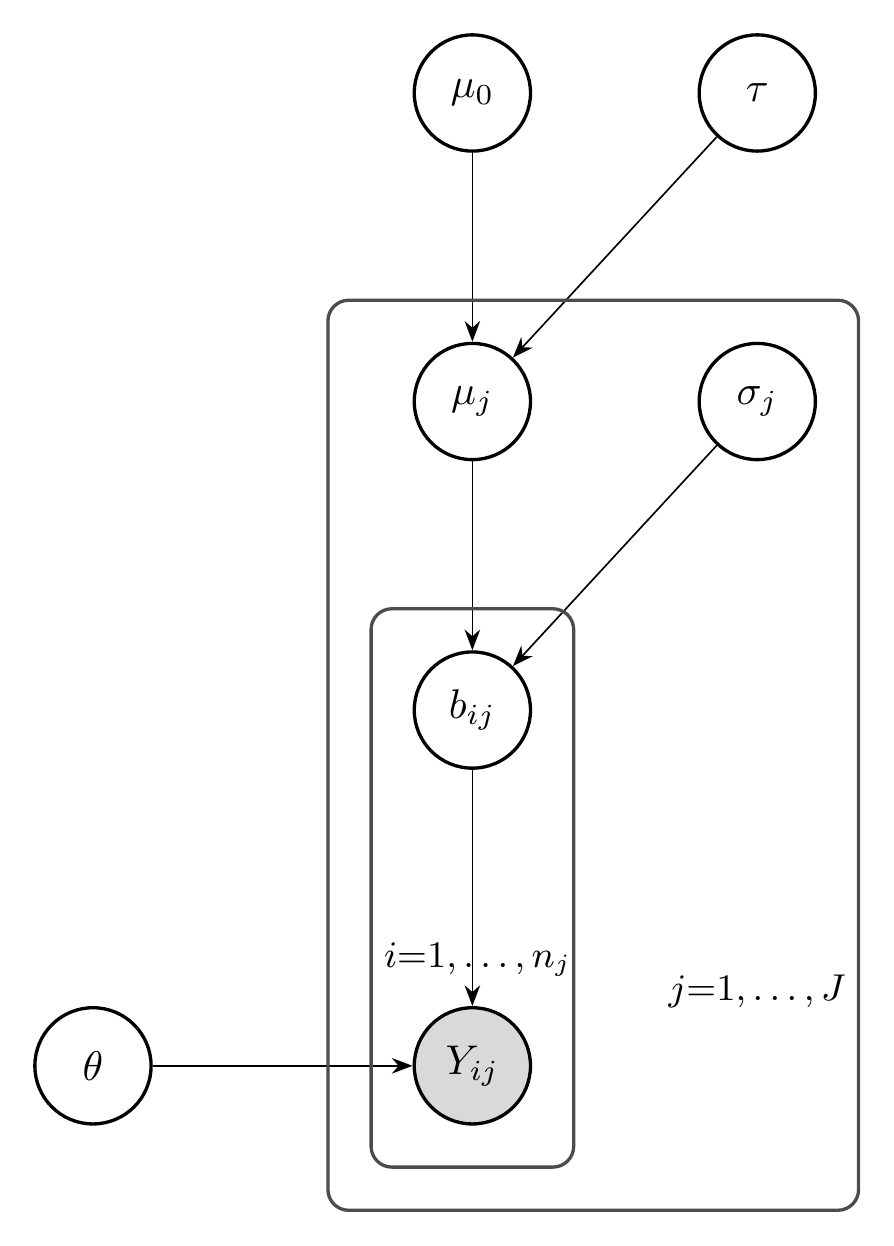
Estimating this model performs partial pooling, interpolating between two extremes. No pooling estimates each benchmark’s difficulties independently—noisy for small benchmarks. Complete pooling uses one global difficulty distribution—ignoring real between-benchmark differences. The hierarchical prior sits between them: an item’s difficulty is shrunk toward its benchmark mean \(\mu_j\) by an amount that depends on how sharply the data pin it down, and the benchmark means are themselves shrunk toward the global mean \(\mu_0\). Items in small or noisy benchmarks borrow strength from their group, and because the hyperparameters \(\sigma_j, \tau\) are learned (by MAP or MCMC; Section 4.5.4, Section 4.5.5), the amount of shrinkage is set by the data rather than fixed in advance. This is the same move as L2 regularization (Section 4.6.1)—a Gaussian prior on the parameters—but with the prior’s scale estimated rather than chosen. Treating all items as exchangeable under a single global prior instead conflates within-benchmark and between-benchmark variation and yields estimates that may not generalize beyond the items observed (Luettgau et al. 2025).
Modern AI evaluations exhibit natural hierarchy at multiple levels:
- MMLU: 15,908 items \(\to\) 57 subjects \(\to\) 4 domains (humanities, social sciences, STEM, other)
- GAIA: agentic tasks \(\to\) 3 difficulty levels \(\to\) capability domain
- Coding benchmarks: problems \(\to\) benchmarks (HumanEval, MBPP, DS-1000) \(\to\) coding capability
Modeling these levels separates the sources of variation at each, which supports principled generalization from the benchmarks actually tested to the broader construct they are intended to measure.
4.5.3 Posterior Computation
Bayes’ theorem gives us the posterior distribution:
\[ p(\theta, \beta \mid Y) \propto p(Y \mid \theta, \beta) \cdot p(\theta) \cdot p(\beta) \tag{4.8}\]
The posterior combines the likelihood (data) with the priors (beliefs). Unfortunately, this posterior is not available in closed form—we need computational methods.
4.5.4 MAP Estimation
The simplest Bayesian approach is maximum a posteriori (MAP) estimation, which finds the mode of the posterior:
\[ \hat{\theta}_{\text{MAP}}, \hat{\beta}_{\text{MAP}} = \arg\max_{\theta, \beta} \left[ \ell(\theta, \beta \mid Y) + \log p(\theta) + \log p(\beta) \right] \tag{4.9}\]
With Gaussian priors, this is equivalent to L2-regularized MLE:
\[ \hat{\theta}_{\text{MAP}}, \hat{\beta}_{\text{MAP}} = \arg\max_{\theta, \beta} \left[ \ell(\theta, \beta) - \frac{1}{2\sigma^2_\theta}\sum_i \theta_i^2 - \frac{1}{2\sigma^2_\beta}\sum_j \beta_j^2 \right] \]
Notice that MAP estimates have smaller variance than MLE estimates. This is shrinkage toward the prior mean (zero).
For extreme scores—models that answer all questions correctly or incorrectly—MLE gives infinite or very large estimates. MAP regularizes these to finite, sensible values. This is crucial for AI benchmarks where some models may achieve near-perfect scores on easy subsets.
The amount of shrinkage is controlled by the prior variance: smaller \(\sigma^2\) means stronger shrinkage toward zero.
4.5.5 MCMC Sampling
To characterize the full posterior distribution (not just its mode), we use Markov Chain Monte Carlo (MCMC) sampling. The Metropolis-Hastings algorithm is a simple but effective approach:
The posterior standard deviations quantify our uncertainty about each parameter. Parameters with more information (e.g., items answered by many models, models who answered many questions) have smaller posterior uncertainty.
4.6 Regularization and Model Selection
4.6.1 L2 Regularization as Bayesian Prior
We have seen that MAP estimation with Gaussian priors is equivalent to L2 regularization. The regularization strength \(\lambda\) relates to the prior variance as \(\lambda = 1/\sigma^2\).
The regularized objective is:
\[ \ell_{\text{reg}}(\theta, \beta) = \ell(\theta, \beta) - \frac{\lambda_\theta}{2}\|\theta\|^2 - \frac{\lambda_\beta}{2}\|\beta\|^2 \]
Regularization prevents overfitting, especially when:
- Some persons have few responses (sparse data)
- Some items have extreme difficulty (near 0% or 100% pass rates)
- The model is complex (many parameters relative to data)
4.6.2 Cross-Validation for Hyperparameter Selection
How do we choose the regularization strength? Cross-validation provides a principled answer: we hold out some data, train on the rest, and evaluate prediction performance.
4.7 Discussion Questions
Identifiability and Interpretation: In AI evaluation, should we anchor the ability scale by fixing one model (e.g., GPT-4 = 0) or by centering all models? What are the implications for interpreting ability scores over time as new models are released?
Bayesian vs Frequentist: When is Bayesian inference preferred over MLE for AI benchmark analysis? Consider scenarios with limited data, extreme scores, or the need for uncertainty quantification.
From Learning to Design: This chapter focuses on estimating parameters from a fixed dataset. Chapter 6 considers how to design the evaluation—choosing which items to include, how to allocate testing effort, and how to ensure robustness. What aspects of the estimation methods learned here would inform good benchmark design?
Transfer of Item Parameters: If we calibrate item difficulties on one set of models (e.g., 2023 models), can we use these parameters to evaluate 2024 models? What assumptions does this require, and when might they fail?
4.8 Bibliographic Notes
4.8.1 Maximum Likelihood Estimation
The theory of maximum likelihood for IRT models is developed comprehensively in Lord and Novick (1968) and Birnbaum (1968). The joint MLE approach and its limitations (incidental parameter problem) were first formalized in Neyman and Scott (1948); Haberman (1977) proves the inconsistency specifically for the Rasch model, and Lancaster (2000) provides a modern survey. For modern computational approaches, see Baker and Kim (2004).
4.8.2 Conditional and Marginal MLE
Conditional MLE for the Rasch model was developed by Andersen (1970), who proved consistency and derived the elementary symmetric functions needed for computation. Marginal MLE was introduced by Bock and Lieberman (1970) and popularized by Bock and Aitkin (1981) using the EM algorithm.
4.8.3 EM Algorithm
The general EM algorithm was formalized by Dempster et al. (1977). Its application to IRT is detailed in Bock and Aitkin (1981). For modern treatments, see McLachlan and Krishnan (2007).
4.8.4 Bayesian IRT
Bayesian approaches to IRT were pioneered by Swaminathan and Gifford (1982) and advanced using Gibbs sampling by Albert (1992). Modern references include Fox (2010) and the software documentation for Stan (Carpenter et al. 2017).
4.8.5 Beta-IRT and Continuous Responses
Standard IRT models assume binary (correct/incorrect) responses, but language models provide richer signals: token probabilities in pre-training and empirical pass rates in repeated sampling. Truong et al. (2025) introduce Beta-IRT, which replaces the Bernoulli loss with a Beta loss parameterized by the IRT logistic mean \(\sigma(d_j(\theta_i - z_j))\) and a precision parameter \(\phi\). This achieves reliable calibration with as few as 2 test takers (30–60\(\times\) fewer than Binary-IRT), making it practical for scaling law studies where the number of model checkpoints far exceeds what binary IRT requires. The connection between per-problem exponential scaling and aggregate power-law scaling is formalized by Schaeffer et al. (2025), who show the power-law exponent is controlled by the left-tail shape of the success probability distribution — precisely the item difficulty distribution in IRT terms.
4.8.6 Optimization Methods
L-BFGS is described in Nocedal and Wright (2006). For deep learning optimizers applied to psychometric models, see Kingma and Ba (2015) for Adam.
4.9 Exercises
4.9.1 Theoretical Exercises
Exercise 2.1 (\(\star\)): Derive the gradient of the Rasch model log-likelihood with respect to \(\theta_i\). Show that it equals the sum of residuals: \(\frac{\partial \ell}{\partial \theta_i} = \sum_j (Y_{ij} - P_{ij})\).
Exercise 2.2 (\(\star\star\)): Prove that the Hessian matrix of the Rasch log-likelihood is negative semi-definite, ensuring the log-likelihood is concave.
Exercise 2.3 (\(\star\star\)): Show that for the Rasch model, the Fisher information for item \(j\) at ability \(\theta\) is \(I_j(\theta) = P_j(1-P_j)\), and that this is maximized when \(\theta = \beta_j\).
Exercise 2.4 (\(\star\star\star\)): Derive the EM algorithm for the 2PL model. What additional complications arise compared to the Rasch model due to the discrimination parameters?
Exercise 2.5 (\(\star\star\)): Show that L2 regularization on the parameters is equivalent to MAP estimation with Gaussian priors. What is the relationship between the regularization strength \(\lambda\) and the prior variance \(\sigma^2\)?
4.9.2 Computational Exercises
Exercise 2.6 (\(\star\star\)): Implement conditional MLE for the Rasch model. Use the fact that the conditional likelihood depends only on item parameters and can be computed using elementary symmetric functions.
Exercise 2.7 (\(\star\star\star\)): Implement a Gibbs sampler for the Rasch model that alternates between: - Sampling \(\theta_i \mid Y, \beta\) for each person (using slice sampling) - Sampling \(\beta_j \mid Y, \theta\) for each item
Compare the posterior estimates to those from Metropolis-Hastings.
Exercise 2.8 (\(\star\star\star\)): Implement marginal MLE using numerical quadrature to integrate out the ability parameters. Compare convergence and parameter recovery to the EM approach from this chapter.
Exercise 2.9 (\(\star\star\)): Implement Beta-IRT estimation. Given a response matrix \(P_{ij} \in [0, 1]\) of empirical probabilities (e.g., token probabilities or pass rates), maximize the Beta log-likelihood \(\sum_{i,j} \log p(P_{ij}; \mu_{ij}, \phi)\) where \(\mu_{ij} = \sigma(d_j(\theta_i - z_j))\) is the IRT-predicted mean and \(\phi > 0\) is a precision parameter. (a) Derive the gradient with respect to \(\theta_i\) and \(z_j\). (b) Simulate data with \(M = 50\) models and \(N = 200\) items, where \(P_{ij} \sim \text{Beta}(\mu_{ij} \phi, (1 - \mu_{ij})\phi)\) with \(\phi = 10\). (c) Compare parameter recovery of Beta-IRT vs. binary IRT (where responses are thresholded at 0.5) as a function of \(M\). Verify the finding of Truong et al. (2025) that Beta-IRT achieves reliable calibration with far fewer models than Binary-IRT.
4.9.3 Discussion Exercises
Exercise 2.9: Compare the convergence of gradient ascent, L-BFGS, and Adam on a Rasch model estimation problem. Which converges fastest? Which is most robust to different initializations?
Exercise 2.10: Investigate the sensitivity of MLE and Bayesian estimation to model misspecification. Generate data from a 2PL model but fit a Rasch model. How do the estimated abilities compare? When does the misspecification matter most?