How subjects answered
- Gemini-3-Pro-Preview incorrect
15.3
Reasoning & Knowledge
Humanity's Last Exam — 2500-question frontier benchmark; per-item binary correct/incorrect from supaihq judged data + deepwriter Gemini-3 data.
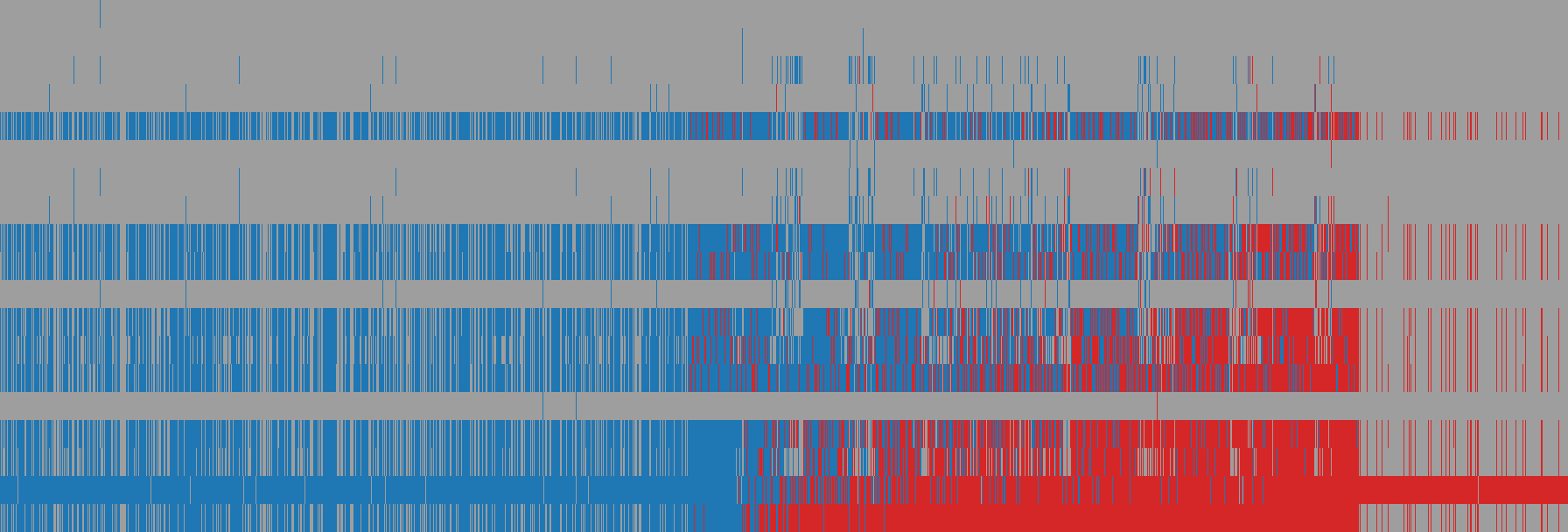
Response matrix
Each row is an AI model and each column an item, ordered so the strongest models and easiest items gather toward one corner. 19 subjects × 1,792 items, 39% of cells evaluated. The heatmap shows a representative 57 of 1,792 items — evenly sampled across difficulty — so each cell stays square and legible.

Scale: 1 = correct · 0 = incorrect
Sample items
A spread of items across the difficulty range, each shown with a few subjects' actual answers.
Humanity's Last Examis gated upstream, so its question text is not redistributed in measurement-db — only an item identifier is stored. The items below therefore show the gold answer and each subject’s response; the questions themselves live on the original benchmark.
How subjects answered
15.3
How subjects answered
## Comprehensive Analysis and Structure Determination Based on the reaction conditions, molecular formulas, and detailed NMR analysis, here are the structures of the three products: ### Starting Material Analysis The starting material is **(S)-1-(3,4-dihydro-2H-pyrrol-5-yl)pyrrolidine-2-carboxylic acid** — a bicyclic system containing a proline unit connected via an amidine linkage to a dihydropyrrole ring. The reaction conditions (excess methyl propiolate, Ac₂O, TEA, 70°C) promote: 1. Formation of a mesoionic 1,3-dipole (Münchnone-type intermediate) 2. Cycloaddition/Michael addition with …
## Comprehensive Structural Analysis of Products A, B, and C I'll systematically analyze each product using the spectroscopic data and reaction conditions provided. ### Reaction Analysis The starting material is a bicyclic carboxylic acid with an amidine linkage between two pyrrolidine rings. Under the conditions (excess methyl propiolate, Ac₂O, TEA, 70°C), multiple reaction pathways occur: 1. **Decarboxylation** (promoted by heat and Ac₂O activation) 2. **Nucleophilic addition** to the activated alkyne 3. **Acetylation** by Ac₂O 4. **Cycloaddition reactions** --- ## **Product A: C₁₄H₂₀N …
Explanation: The reaction of the α‑amino acid bearing two dialkylamino nitrogens with acetic anhydride/Et3N rapidly gives the corresponding N‑acetyl azlactone (Erlenmeyer oxazolone). In the presence of excess methyl propiolate, two competitive follow‑up processes occur: - conjugate addition of the tertiary amine to methyl propiolate to give a β‑enamino ester, and - capture of the azlactone to give an N‑acyl imide after methanol loss. The three isolated components match these three possibilities and their NMR data are diagnostic: Product B (the azlactone) - Structure: N‑acetyl‑2‑oxazolin‑5‑o …
How subjects answered
Looking at this problem, I need to analyze the data generation process and match it to the correct JAGS model specification. ## Analyzing the Data Generation Process The key equation for y is: ```r y = (rnorm(length(x), country, .1)^2)*x + rnorm(length(x), continent, .1) + rnorm(length(x), 0, 1)^2 ``` **Key structural features:** 1. **Response distribution**: The second term `rnorm(continent, 0.1)` can produce negative values when continent ≈ -1 (since L is Uniform(-1,2)). This means y can be negative, ruling out Gamma and Poisson distributions. 2. **Relationship with x**: The term is lin …
Explanation: To determine the correctly specified JAGS model, we must analyze the data generation process for the variable `y` and compare it to the structure of each model. ### 1. Analysis of the Data Generation Process The dependent variable `y` is generated by the following R code: ```R y = (rnorm(length(x), country, .1)^2)*x + rnorm(length(x), continent, .1) + rnorm(length(x), 0, 1)^2 ``` Let's break down the components of `y`: * **Term 1: `(rnorm(length(x), country, .1)^2)*x`** * A normal distribution with a mean centered on the `country` value is squared. Squaring a random var …
Explanation: Model 1 is the only one that uses a normal distribution for y, which is necessary because the data generation process allows for negative y values. It also has a nested hierarchical structure for both intercepts and slopes, which aligns with the nested nature of countries within continents in the data generation. While there is a apparent syntax issue with 'dnorm(mu, tau)' instead of 'dnorm(mu[i], tau)', this appears to be a transcription error in the problem statement, as similar issues appear only in the normal models, and Model 1 otherwise has correct loop indexing and no unuse …
How subjects answered
## Synthesized Analysis Looking at the evidence from all models, I need to identify all edges (co-appearances in TV miniseries or single seasons from 2017-2022) between these six actors. ### Confirmed Edges: **1. Aaron Ashmore — Emilia Jones** Both appeared in *Locke & Key* (Netflix, premiered February 7, 2020). [Locke & Key (TV series) - Wikipedia](https://en.wikipedia.org/wiki/Locke_%26_Key_(TV_series)) **2. Krysten Ritter — Charlie Cox** Both starred in *The Defenders* miniseries (premiered August 18, 2017). [The Defenders (miniseries) - Wikipedia](https://en.wikipedia.org/wiki/The_Defe …
Based on the relationships between the actors and the release dates of their shared projects: 1. **Aaron Ashmore & Emilia Jones**: Both starred in the Netflix series **"Locke & Key"**, which premiered in **2020**. This creates an edge. 2. **Aaron Ashmore & Thomas Elms**: Both starred in the series **"SkyMed"**, which premiered in **2022**. This creates an edge. 3. **Aaron Ashmore & Devery Jacobs**: Both appeared in the series **"Cardinal"**. Ashmore joined the cast in Season 1 (2017) and was a main character in Season 3 (released **2019**), where Devery Jacobs also played the character Sam …
Explanation: The graph consists of six nodes representing the actors. Edges exist between Aaron Ashmore and Emilia Jones (via Locke & Key, 2020-2022), Krysten Ritter and Charlie Cox (via The Defenders, 2017), Devery Jacobs and Thomas Elms (via The Order, 2019-2020), and Aaron Ashmore and Thomas Elms (via SkyMed, 2022). This forms two connected components: one with Krysten Ritter and Charlie Cox, and another with Aaron Ashmore, Emilia Jones, Devery Jacobs, and Thomas Elms. The graph is disconnected and contains no cycles, making it a forest. [Aaron Ashmore - IMDb](https://www.imdb.com/name/nm00 …
How subjects answered
## Explanation The Tale of Genji has 54 chapters, with chapters 2-53 associated with the 52 distinct Genji-kō (源氏香) incense patterns. These patterns represent all possible partitions of a 5-element set (the Bell number B₅ = 52). [The Art and Mathematics of Genji-Kō](https://www.oranlooney.com/post/genji-ko/) Chapter 39 is titled **Yūgiri** (夕霧, "Evening Mist"). In the Genji-kō game, five incense sticks are burned, and players identify which ones share the same scent. The results are recorded using diagrams where five vertical lines represent the incenses, and horizontal connections indicate …
- meaning incense sticks 1 and 4 are the same scent, and incense sticks 3 and 5 are the same scent, while stick 2 is different from all others. From the complete table in the authoritative source, chapter 39 (夕霧/Yūgiri/"Yūgiri" or "Evening Mist") corresponds to the partition: **{1, 4}, {2}, {3, 5}**. This means: - Incense sticks 1 and 4 share the same scent (grouped together) - Incense stick 2 has a unique scent (singleton) - Incense sticks 3 and 5 share the same scent (grouped together) Sorting the sets increasingly by their smallest element, and sorting within each set: **Answer:** $\{\{ …
Explanation: The Tale of Genji features 54 chapters, with chapters 2 through 53 associated with the 52 distinct incense patterns (genji-kō or genjimon) used in the traditional Japanese incense ceremony. These patterns represent all possible partitions of a 5-element set, where vertical lines correspond to incense sticks numbered {1,2,3,4,5} and horizontal connections indicate sticks sharing the same scent. The patterns are systematically ordered from all sticks separate (chapter 2) to all sticks combined (chapter 53) based on the number of connected groups and lexicographic ordering. Chapter …
How subjects answered
C.
Subjects
19 subjects, ranked by mean response (accuracy) across this benchmark's items.